Surplus Elites and Revolution | Edgar and Co.
- [>] +elite overproduction: Surplus Elites and Revolution | Edgar and Co. (@2026-07-11) •workfutures.io
- 'When a society produces more highly educated, wealthy people than it has elite positions to accommodate them, it triggers elite overproduction and a structural bottleneck. This mismatch creates a volatile class of frustrated "elite aspirants" who possess the training, resources, and motive to weaponise working-class anger and overthrow the system that locked them out.'
body
When a society produces more highly educated, ambitious people than it has elite positions to hold, a frustrated class of credentialed aspirants emerges who have the training to critique the existing order and the motive to overthrow it.
Revolutions are rarely led by the poorest. Russian revolutionary Vladimir Lenin was a lawyer born in an affluent family, part of Russia’s elite, and a graduate with a first-class degree. The French Revolution is predominantly associated with the poorest peasants and urban workers, the sans-culottes, rising up against the snobbish and out-of-touch elitists. Yet the core leaders of the uprising were intellectual professionals belonging to the Bourgeoisie, a term Karl Marx later used in The Communist Manifesto to describe the wealthy, privileged social class. In fact, out of the 600 delegates elected to represent the commoners (the Third Estate) in 1789, roughly half were lawyers or legal officials; even the infamous leader of the Reign of Terror, Maximilien Robespierre, was a university-educated lawyer who won a prestigious scholarship to the elite Lycée Louis-le-Grand in Paris. (Estates General of 1789, 2024)
Yes, they were not part of the hereditary aristocracy; however, their origins can be traced to families of merchants, doctors, local officials, and landowners. This provided them with the “Bourgeoisie Advantage”,[1] as they possessed the disposable income required to spend months in Paris debating politics without needing to perform manual labour.
Therefore, it is rather ironic that Robespierre achieved his peak political influence by executing King Louis XVI for high treason in 1793, when just 23 years before that, he delivered a welcome address in Latin to the very man he condemned to death, whilst wearing powdered wigs, silk stockings, tailored waistcoats, and silver-buckled shoes, the immaculate style of the upper classes. Hence, we can conclude that Robespierre was undoubtedly financially and socially much closer to the aristocrats he executed than to the peasants he claimed to represent.

King Louis XVI was executed by Charles-Henri Sanson, the previous Royal Executioner, who executed dissidents previously for King Louis XVI
This pattern, known today as “the elite overproduction,” is used to explain a string of historical upheavals, a pattern I’ll argue is evident in several societies today.[2] Now, this idea dates back to pre-revolutionary France. In Tocqueville’s The Old Regime and the Revolution (1856), it is observed that when absolutism shuts down real political life, an abstract “men of letters” fill the vacuum and become the country’s effective political class. These writers with no governing experience proceed to produce sweeping theories that are carried out by a frustrated literate class.
A century later, historian Crane Brinton produced a comparative study of the English, American, French, and Russian revolutions and found recurring “uniformities” before each. The desertion of the intellectuals, or the transfer of allegiance of the intellectuals, he argues, is the main uniformity: the educated class withdraws its loyalty from the regime, and aligns with the opposition, due to government financial breakdowns, the sense that they are locked out from careers, and a ruling class that loses faith in itself. Sounds familiar?
The total public debt-to-GDP ratio in America is roughly 122.6%, the underemployment rate for recent graduates remains at a staggering 41.5% (meaning two in five young graduates are working in jobs that do not require a college degree), and there has been a noticeable retreat from the “Washington Consensus” followed during the period of the Pax Americana, when the American ruling class universally championed global free trade and open borders; today, both major political parties have pivoted towards protectionist tariffs and strict border crackdowns, a signal that the previous models built for 50 years are no longer viable. (Service, 2024)
We must note that Brinton has his own caveat in the later edition, where he argued that a degree of intellectual alienation is normal in the modern West, so it is not, in itself, sufficient; hence, we must find a different model to answer our question. To do so, I’d like to bring us to one of my favourite political scientists, Jack Goldstone’s Revolution and Rebellion in the Early Modern World (1991). In which he proposed a structural-demographic theory that links state breakdown to the products of population growth: youth bulges, urbanisation, elite competition for a fixed number of positions, a fiscal crisis of the state, etc. Goldstone laid out a distinction between a revolution (a deep structural transformation, with divided elites against the state) and a rebellion (a narrower, restorative one). And thanks to Peter Turchin, who took this framework, added data alongside the cyclical claim, and applied it to the present-day US in his book End Times (2023), which inspired me to dive deeper into this subject.
The mechanism can be explained as such:
- A society prospers and expands education; now, more people gain the credentials that qualify them for elite status.
- However, the number of elite positions, such as senior offices, tenure, or political power, remains roughly fixed.
- Aspirants start to outnumber positions, intensifying competition and making it zero-sum, with spillovers outside normal institutional channels.
- Simultaneously, a “wealth pump” widens inequality, so the stakes of winning rise and the cost of losing rises.
- As this growing pool of credentialed people is denied the status they were promised, they are disappointed and radicalised.
- Some become counter-elites, and, due to the rhetorical and organisational training they possess to articulate grievances and lead, they channel mass discontent against the establishment.
- Add a trigger in the form of a shock or a state fiscal crisis, and you get rupture.
The masses are, of course, important too, but traditionally mainly in their ability to supply numbers, and a revolution would indeed require both the disappointed elite and the masses. Turchin also describes four types of elite, and overproduction in any of these leads to instability in a society:
- Economic: wealth
- Political: administrative office
- Military: force
- Ideological: ideas and legitimacy
Perhaps a more recent case is needed for a proof-of-concept? Then look no further than the Middle East in the 2000s. In Egypt and Yemen, roughly 60% of the population was under 30 by 2010; the youth bulge. The economies were dominated by the state and ruled by cronyism, leading to low private job creation, and decades of rising educational attainment left university graduates with higher unemployment than people with only primary schooling; education without absorption. This graduate unemployment problem led to educated, jobless young people protesting in Tunisia, and was one of the major contributing factors to the Jasmine Revolution, which ended with the ousting of the dictator Ben Ali; the trigger (Achy, 2010).
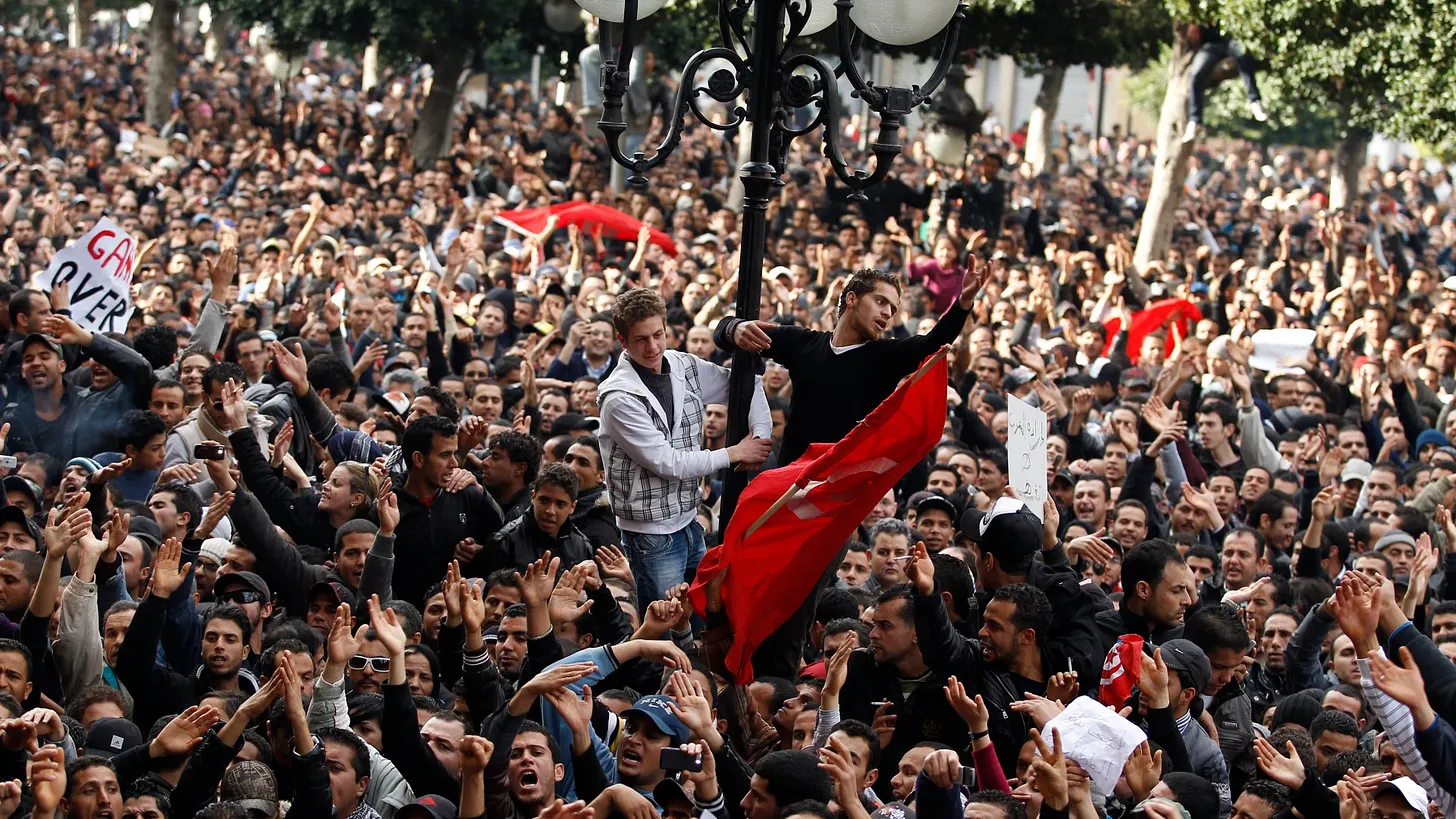
Protestors in crowds comprised mostly of young men who were fed up with unemployment rates. President Ben Ali fled after 28 days of demonstrations
Of course, there will be some examples that do not follow this mechanism, because the pattern is not destiny. Victorian Britain did produce a surplus of educated and ambitious men, but we know that Britain did not suffer the effects of “the elite overproduction.” Why? There were three unique advantages that the British Empire possessed to defuse the pressure:
- Emigration - The Empire was enormous and could afford to absorb surplus elites abroad in colonies such as India and Australia; most were given roles within the bureaucracy and the military.
- Industrialisation - As the home of the Industrial Revolution, new high-status roles were created at a rapid rate, and companies expanded so rapidly that they required new managers, executives, and accountants.
- Electoral reforms - Legislation such as the Reform Act 1832 extended the franchise and provided more opportunities for the educated men of Britain to join the elite, and prevent resentment against the establishment.
So the outcome is, in a way, a policy choice rather than a law of nature. However, these factors were quite situational to Britain back in the 1800s. In most countries in the West, electoral reform can be described as “maxed out,” because universal suffrage has been achieved and there aren’t really as many opportunities for the educated youth to break into politics, especially in America where even the cheapest congressional race in the 2024 US Elections required over $140,000 for Tennessee Representative Scott DesJarlais despite his congressional district being considered a safe Republican seat. (Scott DesJarlais Campaign Finance (2024), 2024)
Onto the second factor: whilst the Industrial Revolution was over two centuries ago, we are going through a bit of an AI revolution ourselves, as our modern knowledge economy is increasingly defined by corporate consolidation and AI-driven efficiency. This revolution, however, does not offer the same opportunities as two centuries ago. The tech and finance sectors have undergone massive waves of layoffs; over 160,000 workers were laid off by tech companies in 2023 alone, and these are sectors which traditionally absorbed waves of ambitious graduates. (Stringer, 2023) Furthermore, the continued automation of work previously performed by entry-level analysts and junior managers means that, while the number of law and business graduates grows every year, the actual number of upwardly mobile “elite” corporate tracks is stagnating and, in some instances, shrinking.
Emigration? There is no geographical frontier or colonial apparatus in the 21st century for any country to absorb surplus domestic elites. The British Empire governed 1/4 of the world at its height in 1921; Russia (the largest country) governs less than 11% of the world’s land, and only 35% of it is considered functionally habitable. (Territorial evolution of the British Empire, 2024) The global order of the 21st century comprises sovereign nations with strict immigration laws and highly competitive domestic labour markets. An underemployed American Ivy League graduate will not be able to move to an emerging economy and automatically step into a high-status bureaucratic or military role. Instead, these frustrated, highly educated individuals remain trapped at home, concentrated in urban centres, where their thwarted ambitions fuel political polarisation and resentment against the existing establishment.
Since we’ve established these conditions do not exist within our society at present, let’s examine the central argument presented by Turchin in his book: the United States is deep into an overproduction crisis.
But before we do that, let’s go back to 2010, when the prestigious scientific journal Nature asked leading scientists to look ahead ten years and forecast the year. The answers focused mostly on breakthroughs in technology or medicine. Turchin instead issued a stark warning based on his historical-demographic models, claiming that the United States was in a spiral of social disintegration that would peak in an “instability spike” around 2020. He used a rather interesting metaphor. Think of deadwood accumulating in a forest; you can easily predict an impending fire from that, but it’s much harder to predict the spark. Turchin predicted that the 2020s would be a decade defined by deep political polarisation, which would lead to a threat of violent upheaval to American democracy, and who dares to even say he’s wrong?
By the time his book was published in 2023, his predictions had already arguably been materialised in the form of the mass social unrest of 2020 and the January 6, 2021, Capitol riots, and Turchin frames that as a validated mathematical forecast. Had he written that book in 2026 instead, it would have also had to include the No Kings Protest on June 14, 2026, which drew over 8 million participants, the attempted assassinations of President Trump, the assassination of the political commentator Charlie Kirk, and even the recent failed attempts by the Trump administration to remove birthright citizenship.
Turchin suggests a 50-year rhythm for political violence in the States, a half-century cycle: the emergence of the Ku Klux Klan in the 1870s, the reemergence of the Klan in the 1920s, the Civil Rights Movement in the 1970s, and now the 2020s. He does provide a rational explanation for this rhythm, in my opinion. After a period of political violence, reforms are implemented that leave about two generations of citizens satisfied. Then, the people who remember why the reforms were made die off, and the elites return to re-rig the system and stress. The current wealth pump supposedly dates back to the 1970s, when the New Deal generation passed. How valid is that statement?
Mainstream economics says “Yes.” Economists overwhelmingly support Turchin’s claim that the wealth pump was turned on in the 1970s, a period known as “The Great Divergence.” There are, once again, three factors that prove this to be true:
- The Productivity-Pay Gap - From 1948 to 1973, worker productivity grew in near-perfect tandem with hourly compensation (both rising ~90%). Once we reach 1973, despite productivity continuing to climb linearly, real wages flattened.
- The Relative Wage Metric - One of the more reliable metrics for tracking inequality is the ratio of median wage to GDP per capita. In the mid-1970s, this ratio plummeted as corporate profits and elite compensation decoupled from average citizen payout.
- The “Great Compression” Rollover - Under Roosevelt, the New Deal era (1930s-1970s) saw wealth inequality compressed due to policies such as the Revenue Act of 1935, which imposed a 79% marginal tax rate on incomes over $5 million. By the late 1970s, the share of total income held by the top 1% had fallen to an all-time low of ~8%. Since then, the wealth pump has been reserved to push the top 1% share past 20%.
US inflation adjusted GDP per capita vs median income : r/dataisbeautiful

The gap between GDP per capita and median income exponentially grows following the 1970s
What does all of this have to do with the surplus of educated elites?
For this to make sense, we must treat the wealth pump as a fuel-injection system that creates the oversupply of elites. As money is shifted from labour to capital, the number of multimillionaires is multiplied exponentially. This new wealth translates into increased demand for elite education and high-status careers. To achieve this, wealthy parents use their capital to push their children into law schools and elite universities. However, while the number of wealthy aspirants multiplied by 3x or 4x, the number of “elite slots” remained entirely fixed. The U.S. still only has 100 Senators, 435 Representatives, 9 Supreme Court seats, and a limited number of Ivy League slots or Fortune 500 CEO positions.
What happens when elite supply vastly outstrips elite demand? You get a massive pool of highly educated, hyper-ambitious, wealthy “game-losers.” These frustrated individuals become counter-elites. Because they cannot enter the existing structure through traditional means, they have a rational incentive to use the “popular immiseration” (the angry, underpaid working class left behind by the wealth pump) to attack and consequently overturn the system. This oversupply of surplus elites fuels the bitter ideological warfare seen in media and politics. Factions of elites weaponise populist anger to destroy their rivals through the dry, deadwood created by popular immiseration, and the desperate leaders willing to strike the match are produced by elite overproduction.
You might think Donald Trump is for the people from the way he describes the working class as “the forgotten men and women” and in the way he fiercely attacks traditional political, media, and corporate elites as corrupt and globalist. I’m sorry to disappoint you, but Trump is a billionaire real estate mogul born into immense wealth, educated at an Ivy League School, and who passed the 2017 Tax Cuts and Jobs Act, which heavily favoured corporations and high-net-worth individuals.als. No, he is not your friend nor a champion of the working class.
I’m sure some of you will have heard of Hasan Piker, known as HasanAbi on Twitch. Is he a prominent socialist commentator who explicitly frames himself as a critic of corporate greed and a revolutionary opposed to the capitalist billionaire class? Yes.
Does he portray himself as an authentic, unfiltered voice of a generation trapped by economic inequality, broadcasting “with” his community rather than “down” to them? Yes.
Is he your friend? No.
Hasan is, in fact, the nephew of Cenk Uygur, the founder of The Young Turks, one of the largest progressive digital media networks. Hasan was directly hired by TYT out of college, without the brutal grind that a normal content creator or journalist would face. Hasan is a multi-millionaire who lives in a $2.74 million mansion in West Hollywood, drives a luxury Porsche Taycan, and wears high-end designer clothing. That is not your working-class champion.
All these different anti-establishment movements rising up throughout the West are structurally led and funded by frustrated segments of the elite class, utilising public rage as a battering ram to gain political power and influence for themselves. Once again, they are not your friends.
By now, I have hopefully shown you that American politics is increasingly led by credentialed insiders fighting each other, and populist movements on both left and right are led by millionaires and billionaires posing as outsiders against a “corrupt establishment.” You might be wondering, is this a problem unique to America?
In the words of our favourite “outsider” President Donald Trump: “Wrong!”

“Wrong!”
China, in fact, might have the purest current case, worse than America, I dare say. In June 2023, a record 11.6 million new graduates came out of the educational system ready to conquer the world and receive the jobs they deserve; youth unemployment reached a record 21.3% by the end of 2023, and afterwards, the government stopped publishing the figure, although they did resume later on with a revised method showing roughly 17%. (China’s Youth Unemployment At Record Highs: Meet The Jobless Graduates | Insight | Full Episode, 2023) Isn’t it amazing how millions suddenly became employed due to a change in how statistics are recorded?
This surplus has been so disastrous that the cultural response among youth has a name: involution (neijuan, 内卷), also known as escaping the rat race in the West. This can be used to describe a state in which increased effort, resources, or education yield diminishing returns, trapping individuals in relentless, meaningless competition with no real progress. Chinese netizens have coined the word “tangpeng, 躺平,” literally translated as lying flat, to describe the deliberate withdrawal and refusal to compete. The Chinese state is actually so worried about this crisis that senior officials have publicly pledged to curb “involutionary” competition; by dragging them out of their beds and confiscating their phones? Can you do that to a 23-year-old grown man? Is the government their mother?
Let’s not kid ourselves into thinking the West is any better off: Canada has the G7’s highest share of highly educated workers, yet its productivity is comparatively weak, and its youth unemployment rate is described as an economic emergency by the Bank of Canada. (Canada’s labour market: between cycles and structural change, 2026) Canada. Graduates clearly no longer enjoy a clear employment advantage; you’d be better off going to trade school and becoming a plumber or electrician at this rate. And over here in Britain, a couple of weeks ago when I took an Uber to dinner, my driver told me he had completed a bachelor’s degree in politics and international relations at the University of Cardiff. I certainly hope that is not what the future has in store for me.
Now I enjoy running a strongman argument, so we’ll go over the strongest counterarguments and critiques possible of the theories I’ve presented and expanded on so far. First critique: various sociological journals have argued that Turchin never consistently defines what a “surplus” elite actually is, so the theory is unscientific. One critic pointed out that the theory defines elites purely by number (e.g., the top 10% of wealth holders) at times. At other times, it is defined by credentials (e.g., law school graduates or PhDs). So a question can be asked: A==t what exact point does a growing class of educated or wealthy people transition from being a healthy, productive meritocracy into a “dangerous surplus”?== If a society has more millionaires, maybe that just means it’s getting richer and more dynamic; could we be overthinking it?
Well, I’d argue that elite overproduction is defined by fixed institutional bottlenecks. Think of it as a brutal, society-wide game of musical chairs. Over time, a society might produce ten times as many qualified players, but the number of chairs remains exactly the same. In society, the number of people with advanced credentials and multi-million-dollar net worths has skyrocketed over the last 40 years, yet the number of actual power positions has remained completely static. There are still only 100 Senate seats, 435 House seats, 9 Supreme Court seats, and a finite number of elite media anchor spots and Fortune 500 CEO roles. The surplus is the measurable, widening gap between the number of people socialised to expect power and the hard ceiling of available institutional chairs. (Elite overproduction, 2024)
Oh, here comes a Marxist, and they’re now arguing that elite overproduction is an incredibly top-heavy, reductionist theory that treats the working class as mindless, inert “deadwood” just waiting for an elite to strike a match. Labour union strikes or the French Revolution were fundamentally driven by the collective agency and suffering of the masses, not just because some frustrated privileged kids couldn’t get government jobs. This theory puts too much focus on elite squabbles and not enough on the bottom-up popular movements that fuel these historical shifts.
Perhaps it’d be easy to frame the relationship between elites and the masses as an “Engine vs Fuel” distinction. The working class’s misery is the fuel of the revolution, but frustrated counter-elites are the engine that gives the fury political direction. In a modern, highly complex society, a political movement requires intellectual and financial capital, something the working class realistically lacks. They can riot or strike out of pure desperation, but to sustain a coordinated political assault on the establishment, you need people who understand how to manipulate media algorithms, navigate legal systems, draft policy, and secure funding. The counter-elites provide the infrastructure for the popular class to cross with their raw democratic force. One cannot succeed without the other.
Welcome, economist Musa al-Gharbi, to the floor. He argues that the theory reverses the direction of the problem. The issue in America isn’t that there is an overproduction of highly educated or ambitious people; it’s that the institutional system has consolidated, causing a collapse in demand for elite labour. There aren’t “too many” smart people; it’s just that corporations and media companies have consolidated into hyper-monopolies, which have destroyed entry-level jobs through automation. The system is failing to absorb them!
In reality, this is just a semantic distinction with the same outcome. Whether you view the crisis as “too much supply” or “too much[3] demand,” the structural outcome is identical. You are left with a class of credentialed people who are deeply resentful of the system, and this betrayal leaves them highly volatile. Turchin’s theory isn’t actually about the overproduction of actual elites but the overproduction of elite aspirants. These people were promised that if they played by the rules, finished their degree, and moved to the city, they would be granted status. So it is no surprise that when the system breaks that promise, it creates a class of radicalised insiders.
Every elite eventually produces more heirs than it has thrones. Author James Baldwin once claimed, “The most dangerous creation of any society is the man who has nothing to lose.” (Baldwin, 1963) Perhaps after reading this article, you might consider that the most dangerous man is the one who was promised something, and got less.
TLDR: When a society produces more highly educated, wealthy people than it has elite positions to accommodate them, it triggers elite overproduction and a structural bottleneck. This mismatch creates a volatile class of frustrated "elite aspirants" who possess the training, resources, and motive to weaponise working-class anger and overthrow the system that locked them out.
(I am not sponsored by Polymarket.)
the Professional-Managerial Class in the US today. ↩︎
No source or citations? No Peter Turchin? ↩︎
little? ↩︎